
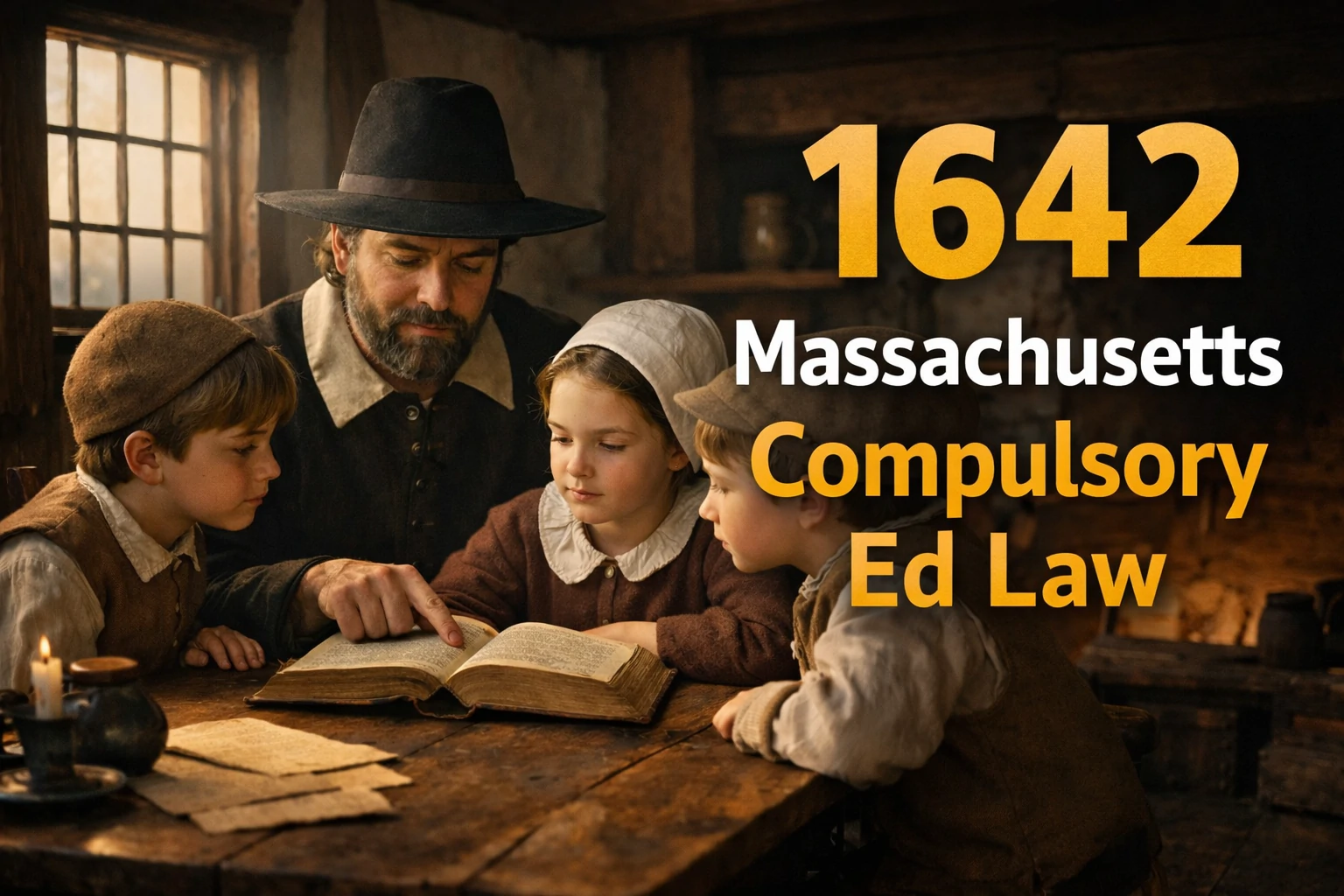
Education did not always feel like a basic right. In early America, learning stayed inside homes and churches. Parents decided what their children learned. Communities offered little guidance. Over time, leaders saw a risk in this loose system. Children who could not read laws or religious texts might weaken society.
In the early 1600s, the Massachusetts Bay Colony faced this concern. Leaders believed literacy helped protect moral order. They feared ignorance more than poverty. That belief shaped one of the most important education laws in American history.
The 1642 Massachusetts compulsory education law did not build schools. It did not hire teachers. Yet it changed how society viewed learning. It made education a duty, not a choice.
This article explains the law in clear terms. It shows why the law mattered. It also explains how it shaped later education rules across the United States.
Life Before Compulsory Education
Before the 1640s, no colony required education. Families taught children basic skills at home. Churches helped when they could. Wealthy families hired tutors. Poor families relied on informal learning.
This system caused uneven results. Some children learned to read well. Others never learned at all. Colonial leaders saw danger in this gap. They believed laws only worked if citizens could read them.
Religion also played a strong role. Puritan leaders believed reading Scripture protected the soul. Illiteracy felt like a moral failure to them. Education became a public concern, not just a private one.
The World That Shaped the 1642 Law
The Massachusetts Bay Colony followed strict social rules. Leaders expected order, discipline, and shared values. Education supported all three goals.
Colonial courts worried about children raised without learning. They feared poor instruction could lead to crime or disobedience. Teaching children felt like protection for the colony itself.
This fear pushed leaders toward action. They wanted a law that respected families but enforced responsibility.
What the 1642 Massachusetts Compulsory Ed Law Required
The 1642 law placed responsibility on heads of households. Parents and guardians had to teach children to read and understand basic rules. Masters of apprentices had the same duty.
Local officials, called selectmen, checked compliance. They could question families. They could step in if education failed. Courts could issue fines. In rare cases, childrenwere moved to other homes for proper teaching.
The law focused on literacy, not school buildings. Parents could teach at home. Tutors could help. The method did not matter. The result mattered.
Why the Law Focused on Parents
Colonial leaders placed trust in families rather than formal institutions. Schools required money, land, and trained teachers. Those resources stayed limited in the early colonies. Home instruction felt practical and realistic under those conditions.
Parents already held moral and legal authority over children. Lawmakers believed parents understood their children best. Teaching at home allowed families to shape lessons around faith, work, and daily life. This approach matched Puritan values that stressed discipline and responsibility.
The law did not remove parental control. It reinforced it. Families kept freedom over how children learned. Courts stepped in only when education failed. This balance reduced resistance and encouraged cooperation.
Education became a shared duty. Families taught daily lessons. Community leaders checked progress. Courts enforced standards when needed. This system linked private life with public order in a new way.
A Simple Summary of the 1642 Law
Many readers want a clear 1642 Massachusetts compulsory ed law summary without complex detail. This section explains it in plain terms.
The law required parents, guardians, and masters to teach children basic reading skills. Officials called selectmen to check whether families met this duty. Courts could issue fines or remove children from neglectful homes.
The law did not require schools. It did not fund teachers. It focused on results, not methods. Literacy mattered more than location.
This approach created accountability. Education stopped being optional. The law treated learning as essential for both faith and civic order. Later education systems grew from this early idea.
Was This the First Education Law in America?
Historians widely view the 1642 law as the first compulsory education law in American history. Earlier colonies encouraged learning but lacked enforcement. Advice carries little weight without consequence.
This law introduced legal oversight. Officials could question parents. Courts could punish neglect. Education gained the force of law.
The shift mattered deeply. Learning changed from a personal choice to a public duty. That idea shaped future education policy across the colonies and later states.
The Massachusetts School Law of 1642 in Context
The Massachusetts school law of 1642 did not solve every problem. Home education varied greatly between families. Some parents lacked skills or interest. Others faced poverty or illness.
Officials noticed these gaps within a few years. Enforcement helped but did not guarantee equal learning. Literacy rates improved slowly and unevenly.
These limits revealed a need for stronger action. Leaders saw that obligation alone could not ensure education. Structure also mattered. This realization led directly to later reforms.
The 1647 Law and Its Stronger Approach
In 1647, Massachusetts passed the Old Deluder Satan Act. This law required towns to hire teachers and open schools. Larger towns had to provide grammar instruction. The goal stayed consistent. Literacy protected faith and law. The method changed. Public responsibility increased.
Education moved beyond the household. Towns gained clear duties. Children gained broader access to instruction. Public schooling began to take shape across New England. This law strengthened what the 1642 law started. Obligation now matched opportunity.
Massachusetts Education Laws of 1642 and 1647 Compared
The Massachusetts education laws of 1642 and 1647 worked as two connected steps.
- The 1642 law enforced the duty to educate.
- The 1647 law created a system to support that duty.
One law demanded responsibility. The other provided structure. Together, they formed the foundation of public education in America. Neither law worked alone. Combined, they reshaped how society viewed childhood and learning.
The Long Path Toward Modern Compulsory Education
Education laws developed slowly after these early acts. Other colonies adopted similar ideas. States later refined them. Attendance laws appeared during the nineteenth century.
The history of compulsory education in the United States begins in Massachusetts but spreads nationwide. Each generation expanded access and enforcement.
Public schools grew. Teacher training improved. Education became central to democracy and civic life. This long path traces back to the choices made in the 1640s.
The Compulsory Education Act of 1922
Many readers ask about the compulsory education act of 1922. This law confirmed state authority over education standards and attendance rules. Courts upheld the right of states to require schooling.
The reasoning behind this authority did not appear overnight. Early colonial laws shaped it. Judges often referenced the long tradition of public interest in education.
The roots of modern education law extend back to 1642. Early ideas gained legal strength over centuries.
What Is Compulsory Education?
Many readers search for what compulsory education is. A clear explanation helps.
Compulsory education means the law requires children to receive a basic education. Parents must ensure compliance. The state enforces rules through schools or approved alternatives.
This system balances family choice with public interest. Education supports literacy, civic knowledge, and social stability. The 1642 law introduced this idea in America.
Accessing the 1642 Law Today
Some users search for a 1642 Massachusetts compulsory ed law pdf. Original texts exist in colonial archives and academic collections. Most appear in old legal language.
Modern summaries offer better clarity for most readers. Historians translate and explain the law in simple terms. These explanations help readers understand intent rather than wording.
Why This Law Still Matters Today
The law reshaped American values. Education became a public duty rather than a private option. Literacy gained legal importance. Society accepted oversight in child learning.
Modern schools, attendance rules, and testing systems trace back to this shift. Education now supports democracy, law, and economic growth.
Understanding this law explains why education holds such a central role today.
Addressing Unrelated Search Queries Seen Online
Some search results mix unrelated phrases with this topic. These include:
- Rubbish on Bournemouth beach
- B3073 road closure
- Body found in Poole
- Bournemouth Echo missing man
- Bargates Christchurch Road closure
- Poole Advertiser
- Bournemouth Airport’s new routes
- Ryanair’s new routes from Bournemouth
These terms relate to UK local news. They have no link to early American education law. Search engines sometimes group trending topics together.
Readers should ignore these results when researching colonial education history.
How to Avoid Confusion When Researching History
Use reliable historical sources. Focus on academic writing and state archives. Avoid news headlines that mix unrelated topics.
Clear research habits save time and reduce error. Good sources provide context, not noise.
The Quiet Power of the 1642 Law
The 1642 Massachusetts compulsory ed law did not build schools. It built responsibility. That quiet change reshaped American society.
Education stopped being optional. Communities gained oversight. Children gained protection through learning.
Modern education debates still echo these themes. Responsibility, access, and authority remain central today.
Conclusion
The 1642 Massachusetts compulsory ed law stands as a turning point in American history. It marked the first time a government required education through law. Families kept control, but the community gained authority.
This law shaped future education systems. It led to public schools. It influenced court rulings. And it defined education as a public good.
The idea began quietly in colonial Massachusetts. Its impact continues across the United States today.
Questions and Answers
What was the 1642 Massachusetts Compulsory Ed Law?
It was the first law in America that required parents to educate their children. Local officials enforced the rule.
Did the 1642 law create public schools?
No. The law focused on home education. Public schools came later through new laws.
Why did Massachusetts pass this law?
Leaders wanted children to read laws and religious texts. Literacy supported order and faith.
How is this law different from the 1647 law?
The 1642 law enforced duty. The 1647 law required towns to provide schools.
Why does this law still matter today?
It shaped the idea that education serves the public good and deserves legal protection.