
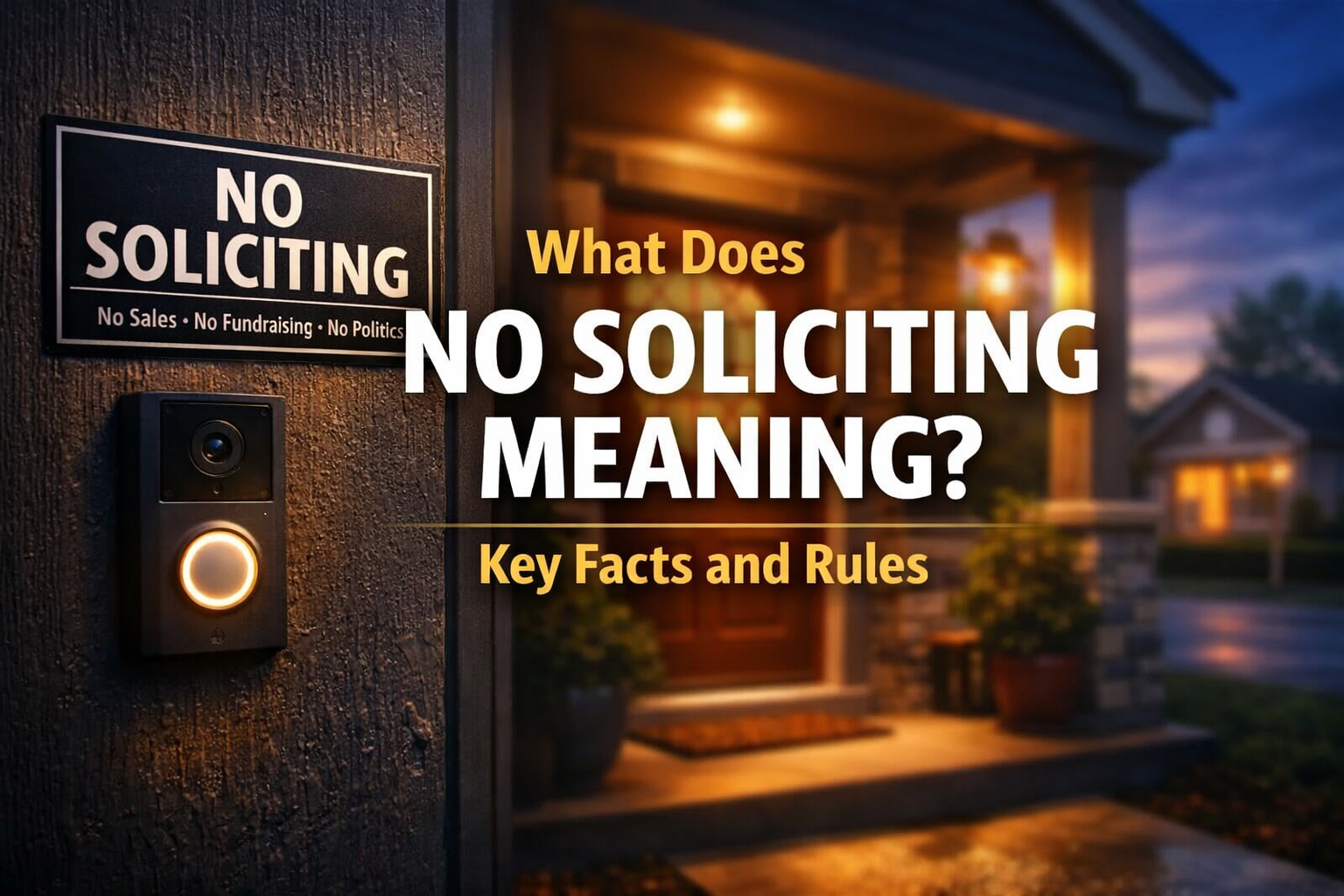
Last summer, a neighbor down the street opened his door at dusk to find a pushy salesperson on his porch. The man would not take no as an answer. My neighbor pointed to a small sign near the bell that read “No Soliciting.” The salesperson left fast after he saw it.
Many homes display that sign. People pass it every day without much thought. Few stop to ask what it truly blocks and what it allows. This article gives you clear answers. You will learn the real meaning, what the law says, what counts as a violation, and how to enforce the rule. You will also see real examples and practical steps you can use at home or work.
Key Points at a Glance
| Topic Area | Key Idea | Practical Action |
|---|---|---|
| Core Meaning | Blocks uninvited sales or promotions | Post a clear sign at the entrance |
| Legal Support | Backed by many city ordinances | Check local code |
| Exceptions | Does not block friends or officials | Verify badges if unsure |
| Enforcement | Fines and warnings possible | Document violations |
This table offers a quick view. Details above give you a deeper context and steps.
Core Meaning of No Soliciting
The phrase “No Soliciting” means that uninvited sales or promotional visits are not allowed on the property. A homeowner or business owner uses it to stop people from knocking to sell goods, promote services, or ask for money.
The sign sets a boundary. It tells strangers that the owner does not want sales talks or requests. That message helps protect privacy and reduces unwanted visits. Many people post it to avoid stress and save time.
Recent homeowner surveys show that a large share of homes in the United States display some form of no-solicit notice. The reason is simple. People value quiet evenings and fewer interruptions.
What Counts as Soliciting
Soliciting covers many types of door-to-door activity. It usually involves someone who approaches a property to sell, promote, or request something. Common examples include:
- Sales pitches for home repairs, cable plans, or alarm systems
- Requests for donations or charity funds
- Petition drives or political canvassing
- Door-to-door marketing for new services
A real case in one town involved a teenager who sold candy for a school trip. He ignored a posted sign. Local officers warned him and later fined his sponsor under the city code. The rule applied even though the cause seemed harmless.
Intent matters less than the act itself. If someone approaches a home without invitation to promote or sell, that act often falls under soliciting.
What No Soliciting Does Not Cover
A no-solicit sign does not block every visitor. It targets uninvited sales and promotional contacts, not normal social or official visits. Friends, family, and invited guests can still knock. Mail carriers, package drivers, and emergency workers may enter as part of their duties. Government workers with proper badges also have access to most areas.
A legal expert once explained it this way: the sign targets uninvited sales, not all visitors. That simple idea helps clear confusion. The sign protects against commercial or promotional contact, not daily life activity.
Actionable Tips Before You Post a Sign
Before you place a notice on your door, take a few smart steps. Local rules may differ from city to city. Here are simple actions you can take:
- Check local codes on city or county websites
- Use clear words such as “No Soliciting,” “No Trespassing, ” or ” No Sales.”
- Add a note that violators may face fines if your area allows it
A clear sign works best when it sits near the doorbell or front entrance. Visibility matters. Small or hidden signs may not hold up in disputes.
Legal Power of No Soliciting Signs
Many cities back these signs with local laws. Municipal codes often state that ignoring a posted notice can lead to fines or warnings. Legal aid groups report that most towns support property owners in these cases.
One Texas family faced repeated visits from roofing scammers after a storm. They documented each visit and reported the violations. The court later issued a fine of $500 against the company. The sign played a key role in that case.
Local ordinances vary, yet the pattern stays similar. Property owners have rights to limit commercial contact on private land. A posted sign helps prove that the visitor had notice of the rule.
Differences by Location
Rules can change based on where you live. A single-family home may follow city code. An apartment complex may also follow lease terms. Homeowners’ associations may add extra layers of control.
HOA rules often strengthen enforcement. They may require uniform signage or allow community patrol reports. That added support can reduce unwanted visits across the block.
An attorney once said that posted notices create enforceable no-trespass zones in many places. That means the sign turns a preference into a formal boundary under local law.
Quick Steps to Make Your Sign Strong
You can take simple steps to improve the power of your notice. A weak sign may not carry the same weight as a clear one. Use bold letters that are easy to read. Place it at eye level near the entrance. Add your address on the sign if local rules suggest it. Some towns let residents register with a police non-emergency line to join a no-knock list. Clear wording plus correct placement helps you stand on firm ground if problems arise.
Where No Soliciting Signs Appear Most
These signs show up in many places, not just private homes. Residential neighborhoods often lead the list. Suburbs tend to display more signs than dense city areas.
One Florida community installed uniform signs at each home entrance. Visits dropped by more than half in a short period. Neighbors felt safer and reported fewer late-evening knocks.
Businesses also use these notices. Retail stores may block outside vendors. Offices often restrict charity drives during work hours. A small coffee shop once fined pushy charity collectors after they ignored posted warnings. The fine reached $200 under the local code.
Online and Digital Twists
The idea of no soliciting has moved online as well. Email filters and spam rules act like digital door signs. They block unwanted promotional contact in your inbox. You can apply simple steps in the digital space:
- Set auto-filters for marketing emails
- Report spam through your email provider
- Use do-not-call registries for phone marketing
Digital rules do not always mirror physical property law. Still, the goal stays the same. People want control over who contacts them and when.
Consequences for Ignoring No Soliciting
Ignoring a posted notice can carry real consequences. Fines vary from town to town. Some cities issue warnings first. Others move straight to monetary penalties.
Municipal data shows that fines can range from $100 to $1,000 per violation. Repeat offenses may lead to misdemeanor charges. One California door-knocker faced legal trouble after multiple ignored signs in one week.
Sellers face bigger risks beyond a single fine. A company may lose its permit. Sales routes can close if complaints pile up. A trainer in the sales field once warned that one sign violation can end a route in certain towns.
Your Response Options
When someone ignores your sign, you have choices. You do not need to escalate at once. You may take these steps:
- Give a calm verbal warning
- Document the visit with time and date
- Call local non-emergency police if the problem repeats
- Install cameras to record activity
A video doorbell can deter many unwanted visitors. Reports from security companies show that visible cameras reduce doorstep contact. Evidence also helps if you file a complaint later.
How to Enforce No Soliciting Effectively
A strong approach blends clear signs with community effort. One sign helps. A group effort helps more. Choose a sign with good contrast. Black letters on white or red backgrounds stand out. A medium size works best. Too small may go unseen. Too large may look informal.
Work with neighbors to adopt similar signs. One Ohio block did this and reduced knocks by almost all reported counts within months. Unity sends a message to companies that target entire streets.
Join a no-knock registry if your city offers one. Update your sign if it fades. Teach children not to open the door to strangers who ignore posted rules. Simple habits create long-term peace.
Conclusion
“No Soliciting” means that uninvited sales and promotional visits are not welcome on a property. The phrase sets a boundary. Local laws often support that boundary with fines or warnings.
Homes, offices, and even online spaces use similar rules to protect time and privacy. Clear signs plus simple follow-up steps reduce unwanted contact. Community effort strengthens results.
A posted notice does more than sit on a door. It sends a clear message about personal space and respect. If peace at your doorstep matters to you, a strong and visible sign may be a smart step today.
Common FAQs
Is no soliciting sign rude?
No, it is not rude. It sets a clear boundary and protects privacy. The sign simply asks salespeople not to knock.
What does soliciting someone mean?
Soliciting someone means asking them for something. It often relates to sales, money, or support. The meaning depends on the situation.
Why do signs say no soliciting?
People use the sign to stop uninvited sales visits. It helps reduce unwanted interruptions. Some cities also support it under local rules.
Is soliciting a negative word?
The word is not always negative. It means to request or seek something. The tone changes based on context.