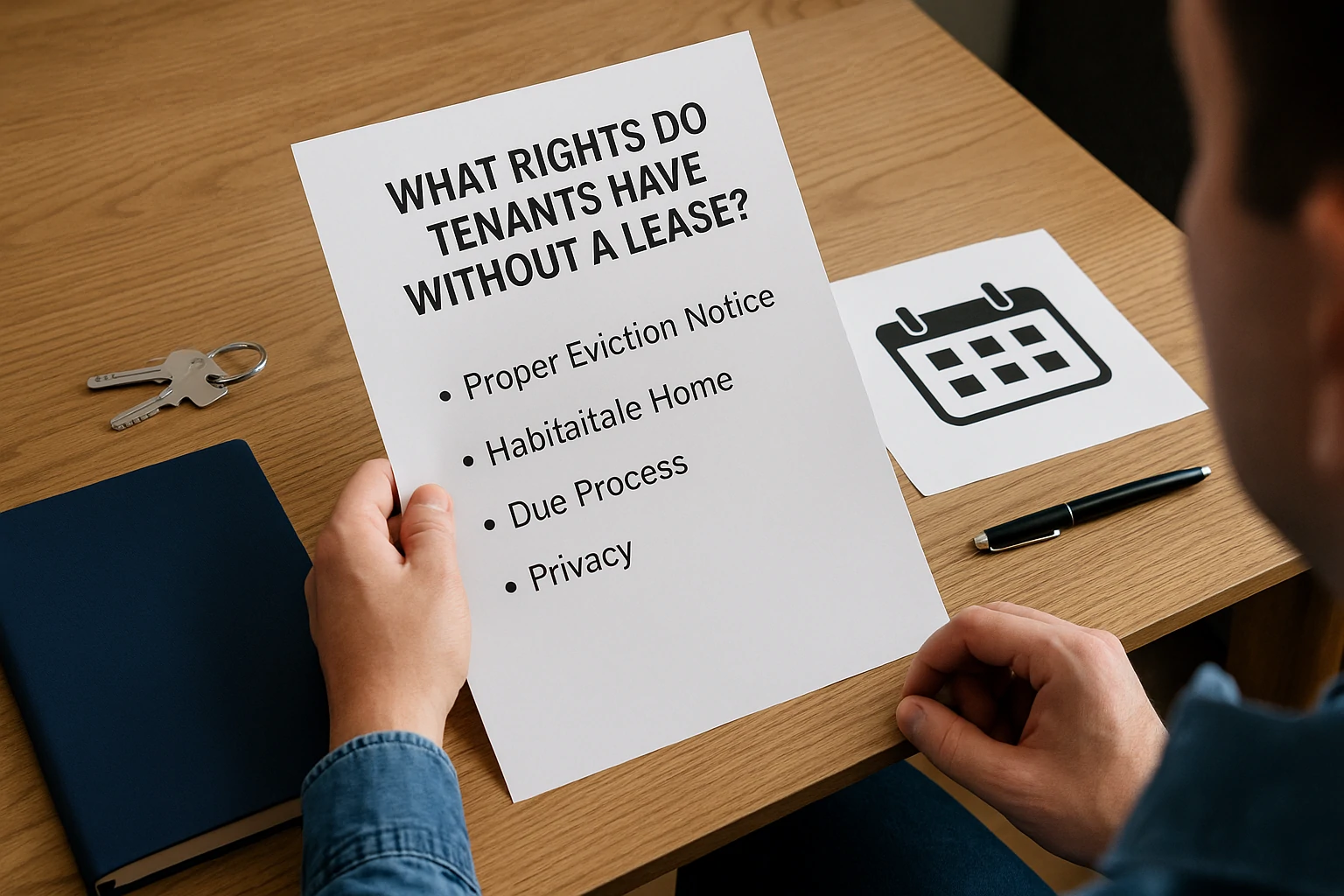
Tenants without a written lease still have legal rights. A landlord cannot remove them without notice, change the locks, shut off essential utilities, or ignore the required court process. Tenants may also have rights related to repairs, privacy, rent increases, security deposits, discrimination, and retaliation.
An oral agreement may create a valid rental relationship. Regular rent payments can also show that a tenancy exists. The law often treats a renter who pays each month as a month-to-month tenant. State and local laws then set many of the rules that a written lease would usually cover.
The exact protection depends on the tenant’s location and type of housing. Notice periods and repair options can differ between states and cities. A tenant should check local law before withholding rent, ending the rental agreement, or refusing a landlord’s demand.
What Does It Mean to Rent Without a Lease?
A person may become a tenant without signing a document. A landlord may accept rent, provide keys, and allow the person to use the home as a main residence. These actions can prove that a landlord-tenant relationship exists, even if both sides made the deal through a conversation.
Most renters who pay once per month have a month-to-month tenancy. The agreement continues one month at a time until either side ends it through the proper legal process. A person who pays each week may have a week-to-week tenancy instead. Local law may use another name for these arrangements.
An oral promise does not always receive the same treatment as a written lease. Some states will not enforce an oral agreement that lasts longer than one year. It can also be hard to prove the agreed rent, due date, deposit amount, pet rules, or repair duties when nothing appears on paper.
What Basic Rights May Apply?
The lack of a signed lease does not allow a property owner to act without limits. State laws, local housing codes, federal fair housing rules, and the terms of any oral agreement may still protect the renter. These laws also place duties on the person who owns or manages the property.
| Possible right | What it may protect |
|---|---|
| Proper notice | Time to pay rent, correct a problem, or move |
| Court process | Protection from removal without a legal eviction order |
| A safe home | Basic heat, water, plumbing, electricity, and structural safety |
| Privacy | Limits on when and why a landlord may enter |
| Fair housing | Protection from unlawful discrimination |
| Deposit rules | Deadlines and limits on lawful deductions |
| Protection from retaliation | Help when a landlord acts against a tenant who reports a valid problem |
This table shows common protections, not one national rule. Each state sets its own notice periods, deposit deadlines, entry rules, and repair options. Cities may add stronger rights through rent control, just-cause eviction laws, or local housing codes.
Federal fair housing law protects renters in most types of housing. A landlord generally cannot treat a person unfairly because of race, color, religion, national origin, sex, disability, or family status. State law may protect more groups, such as veterans, older adults, or people who receive public aid.
Can a Landlord Evict a Tenant Without a Lease?
A landlord may end a tenancy without a written lease, but the landlord must follow the law. The usual process starts with a written notice. If the renter does not leave or solve the stated problem, the owner may file an eviction case in court.
A landlord cannot usually change the locks, remove the tenant’s property, block access, or shut off services to force the tenant out. These acts may count as an illegal lockout or self-help eviction. Only a sheriff, constable, or another authorized officer can carry out a court order in most places.
The landlord may not always need to prove that the renter did something wrong. Some states allow an owner to end an ordinary month-to-month tenancy after proper notice. Other states and cities require a legal reason, such as unpaid rent, serious damage, repeated rule violations, or a lawful owner move-in.
How Much Notice Must a Tenant Receive?
No single notice period applies across the United States. A month-to-month tenant may receive 30 days in one state and a different amount of time elsewhere. Some laws provide more time after a person has lived in the home for one year or longer.
The reason for the notice also matters. A notice for unpaid rent can provide only a few days in some states. A notice that ends a tenancy without fault may provide much more time. Local just-cause laws can also limit the reasons an owner may use.
A notice may need to state the amount of unpaid rent, the deadline, the address, and the action required from the renter. State law also controls how the notice must reach the tenant. Personal delivery, mail, door posting, or a set mix of these methods may apply.
Does a Tenant Have a Right to Repairs?
Many states require landlords to provide basic health and safety conditions. Common duties cover working plumbing, safe electrical systems, secure doors, weather protection, and access to essential services. Local building codes may impose more detailed standards.
A tenant should report a defect in writing and allow a reasonable amount of time for a response. The message should describe the problem, its location, and any danger it creates. Dated photos, videos, repair requests, inspection reports, and copies of all replies can support a later claim.
A renter should not stop rent payments or pay for a repair and deduct the cost without legal advice. Some states allow these options under strict conditions, but others do not. A housing inspector, tenant lawyer, or legal aid office can explain which remedy applies in the tenant’s area.
Does a Tenant Without a Lease Have Privacy Rights?
A rented home remains the tenant’s private space. The landlord does not gain an unlimited right to enter merely because no written agreement exists. State law may limit entry to repairs, inspections, property showings, or other valid reasons.
Many states require advance notice before a routine visit. The required period may be 24 hours, two days, or another reasonable amount of time. Some states have no fixed statewide period, so the oral agreement, local rules, and the right to quiet use of the home may matter.
An emergency can allow immediate access. A fire, gas leak, burst pipe, or urgent risk to people or property may justify entry without advance notice. The owner should not use an emergency rule as an excuse for repeated visits, harassment, or checks that have no valid purpose.
Can the Landlord Raise the Rent?
A landlord may often raise the rent in a month-to-month tenancy, but the increase cannot usually take effect without advance notice. The amount of notice depends on state and local law. The rent cannot rise for a past rental period that the tenant already paid.
Some cities limit how much an owner can raise the rent. Other places have no general cap but still require proper notice. Special rules may apply to rent-controlled homes, subsidised housing, mobile home parks, or properties covered by a local tenant protection law.
A rent increase cannot serve as punishment for a lawful complaint where retaliation laws apply. It also cannot target a tenant because of a protected trait. A renter who believes an increase is unlawful should keep the notice and seek local advice before paying a different amount.
What Happens to the Security Deposit and Utilities?
A security deposit remains the tenant’s money until the landlord has a lawful reason to keep part of it. State law may set a return deadline and require an itemised list of deductions. Normal wear, such as minor carpet use or faded paint, does not usually count as tenant damage.
Separate account and interest rules differ by location. Some states require special deposit accounts only for certain properties or landlords. A tenant should keep proof of the original payment and take dated photos at move-in and move-out.
A landlord generally cannot cut water, heat, power, or another essential service to force someone to leave. The renter should contact the utility company and local housing office if a service stops. An immediate danger may also justify a call to emergency services or local law enforcement.
What Duties Does a Tenant Have Without a Lease?
Tenant rights come with legal duties. The renter must pay the agreed rent on time, keep the home reasonably clean, avoid serious property damage, and follow valid health and safety rules. The tenant may also bear responsibility for damage caused by household members or guests.
A tenant should not assume that a verbal deal removes all property rules. An owner may enforce reasonable rules that formed part of the original agreement. New rules may require advance notice, and they cannot conflict with state law or target one renter for an unlawful reason.
The renter must also provide proper notice before moving out. A month-to-month tenant often owes notice equal to one rental period, but the rule varies. A person who leaves without enough notice may owe more rent even after moving to another home.
How Can a Tenant Prove the Rental Agreement?
Payment records offer some of the best proof. Bank transfers, checks, money order receipts, payment apps, and signed cash receipts can show the rent amount and payment schedule. The renter should avoid cash payments without a receipt.
Messages can also prove the terms of the deal. Emails and texts may confirm the move-in date, deposit, rent, utility duties, repair promises, and permission to keep a pet. Copies should remain in a safe place that the tenant can access outside the rental home.
A simple written rental memo can prevent future disputes. It can list the property address, monthly rent, due date, deposit, included utilities, and notice terms. Both sides should sign and date it, even if they do not want a long formal lease.
What Should a Tenant Do When a Dispute Starts?
The first step is to collect proof. The tenant should save notices, rent records, photographs, messages, and the names of any witnesses. A dated written reply can correct false claims and show that the renter took the issue seriously.
The next step depends on the problem. A housing department may help with unsafe conditions. A fair housing agency can review possible discrimination. Legal aid, a tenant association, or a licensed attorney can explain eviction notices, rent disputes, lockouts, and deposit claims.
Court papers need quick attention. A tenant should not ignore a summons because the landlord made an error or acted unfairly. The renter may lose by default if no response reaches the court before the deadline.
Conclusion
A tenant can have important rights without a written lease. Those rights may cover proper notice, a legal eviction process, basic safety, privacy, fair treatment, essential utilities, and security deposit protection. Rent payments and the landlord’s conduct can help prove that a tenancy exists.
The absence of paperwork still creates risk. Each side may remember the oral deal in a different way, and local rules may provide less protection than the renter expects. Clear records and written messages can prevent a small disagreement from becoming a major dispute.
State and city laws control the final answer in each case. Tenants should check an official local source before they withhold rent, refuse an increase, make repair deductions, or leave without notice. This article provides general information and does not replace advice from a licensed attorney.